

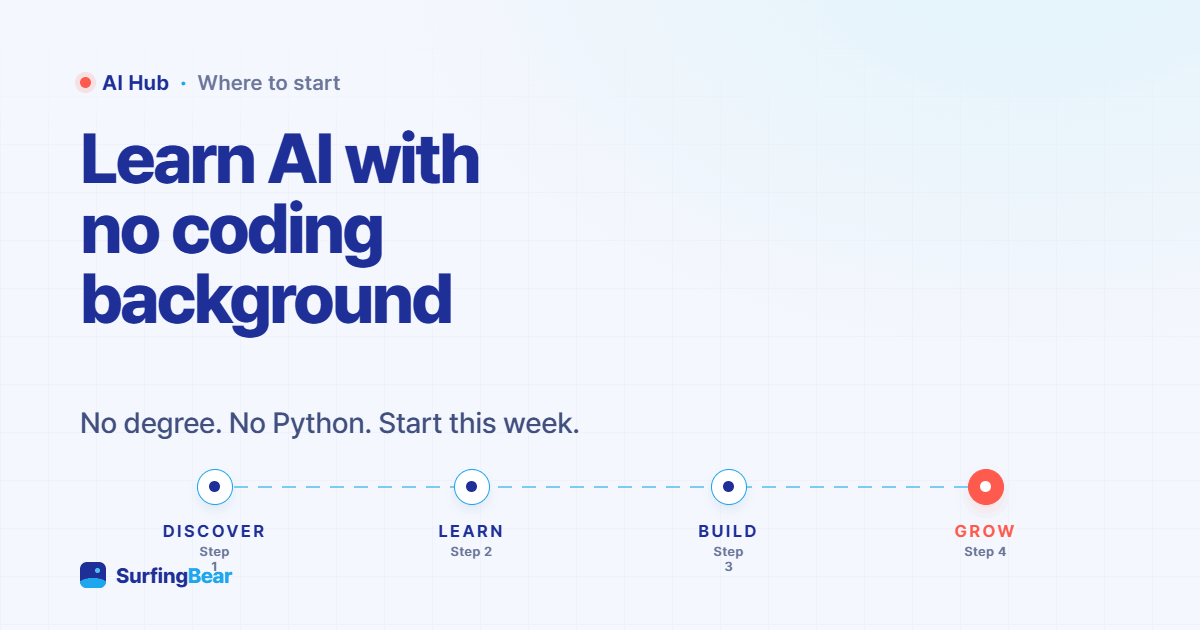
If you've been told that AI is only for engineers, that wall is mostly imaginary now. In 2026 the most useful skill isn't writing model code — it's knowing how to use AI to do real work. Here's a practical, India-first path from zero to your first project, with no degree and no Python required.
1Can you really learn AI without coding?
Yes — and not in a watered-down way. The thing most people call "AI" day to day is a set of tools you talk to in plain English (or Hindi, or Tamil). You describe what you want, you check the result, you refine. That loop is the core skill, and it has almost nothing to do with syntax.
Coding still matters if you want to train models from scratch or work deep in the research stack. But the overwhelming majority of jobs and side-projects that "use AI" are about applying it well: writing sharper prompts, wiring tools together, judging output, and knowing when the machine is wrong. You can get good at all of that this week.
"You don't need to code to start. You need to start."
2Why "no coding background" stopped being a blocker in 2026
A few years ago, doing anything with AI meant a terminal, a GPU, and a pile of Python. That's no longer where most of the value is. Three shifts changed the game:
- Natural language is the interface. You instruct powerful models the same way you'd brief a colleague.
- No-code builders matured. You can connect AI to your data, your spreadsheets, and your apps by dragging boxes, not writing scripts.
- The tools come pre-built. Assistants, automations, and app-builders ship ready to use — you bring the problem, not the plumbing.
The result: the entry point moved from "learn to program" to "learn to think clearly about a problem and direct a tool at it." That's a door far more people can walk through.
3What you actually need (and what you can skip)
Beginners waste months preparing for a journey they could start today. Here's the honest split.
What you actually need:
- A real problem you care about — from your job, studies, or daily life.
- A rough mental model of how AI "thinks": it predicts, it doesn't know.
- Willingness to try, read the output critically, and iterate.
- Four to five focused hours a week.
What you can safely skip — for now:
- A computer science degree.
- Python on day one.
- Heavy maths and linear-algebra theory.
- An expensive laptop or your own GPU.
4How to start learning AI with no coding background, in 4 steps
This is the SurfingBear path. Each step is small enough to start now and strong enough to build on.
Discover
Spend a week spotting where AI already touches your work. Pick one real problem worth solving.
Learn
Learn how models think and how to prompt them well — judgement and concepts, not syntax.
Build
Ship one small, real thing with no-code and AI tools. A working draft beats a finished plan.
Grow
Repeat with harder problems, share what you make, and let your portfolio compound.
5A realistic first month (4–5 hours a week)
You don't need to quit anything or block out weekends. Here's what a steady, part-time month looks like.
4 hrs
Discover — explore the main AI tools and list three problems from your own life worth solving.
5 hrs
Learn — get fluent at prompting and judging output. Understand what models can and can't do.
5 hrs
Build — make one small thing: an automation, a helper, or a simple AI-powered page.
4 hrs
Grow — polish it, share it publicly, and write down what you'd do differently next time.
6The mistake almost every beginner makes
They collect. Course after course, video after video, a folder of bookmarks that never gets opened. It feels like progress, but it's just motion. The tutorial loop is comfortable precisely because nothing is ever at stake.
The fix is uncomfortable and simple: build before you feel ready. Pick the smallest possible version of a real project and ship it this week, badly if needed. You'll learn more from one finished, flawed thing than from ten courses you "completed." Confidence is a by-product of building, not a prerequisite for it.
7Where SurfingBear fits
SurfingBear is built for exactly this path, India-first. We don't hand you another endless playlist — we curate a tight, current set of AI tools and starting points so you can spend your hours building, not searching. Discover what's worth your time, learn the few things that matter, build something real, and grow from there.