

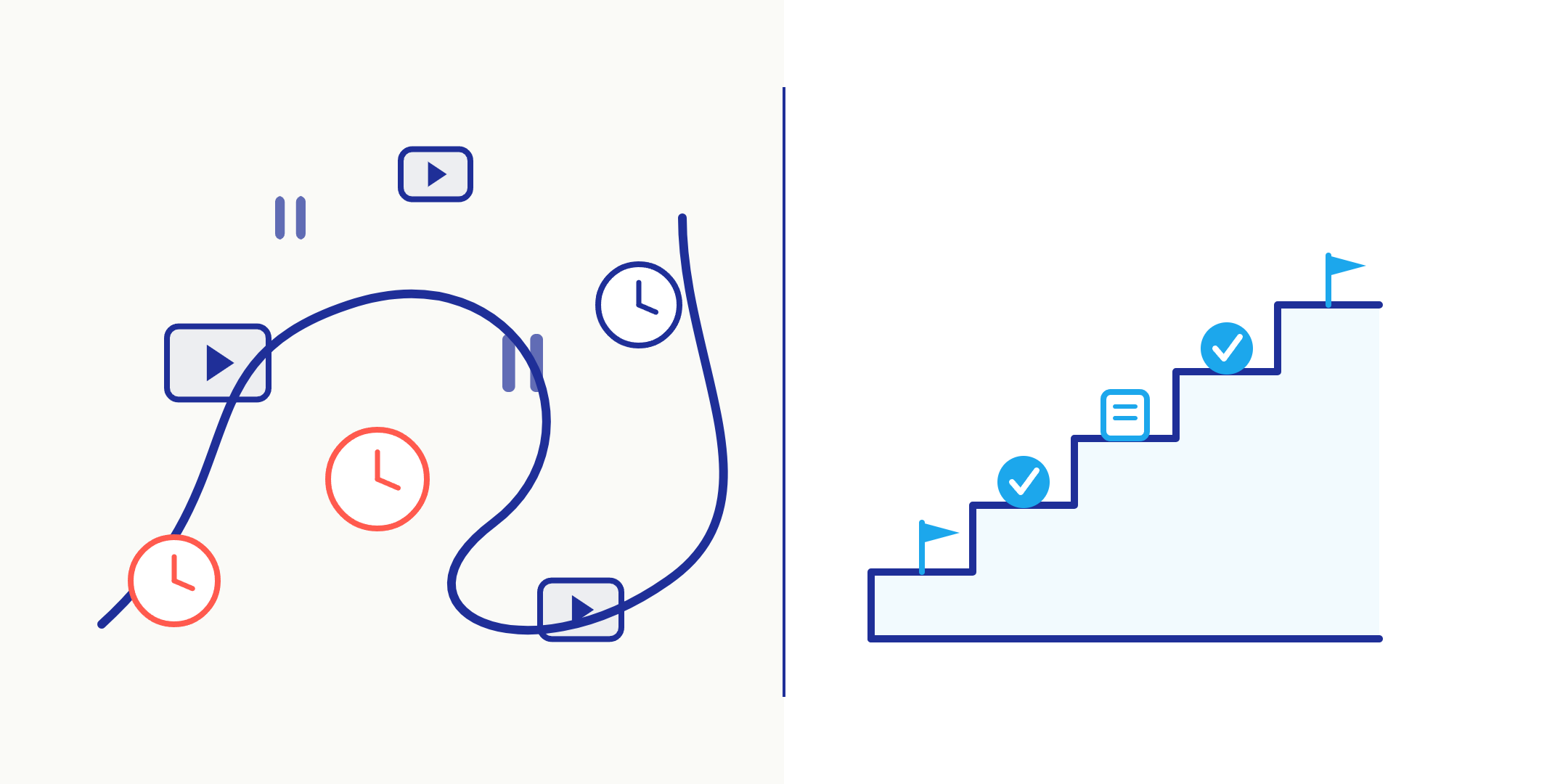
It’s 3:47 PM on a Saturday. You’re back from grocery shopping, you’ve made Tea, and you’ve opened YouTube with the genuine intention of finally cracking RAG architecture. You’re on the third 47-minute video. The first explained vector databases beautifully. The second contradicted the first on chunking strategy. The third spent 12 minutes on the channel host’s own GPT-wrapper SaaS.
It’s now 6 PM. You’ve watched 2.5 hours of content. You can’t actually build the thing.
This is the modal Indian AI learning experience in 2026.
YouTube isn’t bad. It’s free. It’s everywhere. It’s where most working Indian pros say they learn most of their AI skills right now (directional from our user-research conversations, not Glassdoor-sourced). It’s the obvious first move.
The problem isn’t YouTube. The problem is that “free YouTube” hasn’t actually been free for at least two years. The cost moved from your wallet to your weekend.
This post is the math on when that cost stops being worth it, and the specific signals that tell you it’s time to switch lanes.
What free YouTube actually costs
Let’s price the “free” path honestly.
A senior IC who’s serious about AI typically spends 6 to 9 hours a week watching YouTube in upskill mode. Call it 7. Over a 12-week quarter, that’s 84 hours.
For a 10-YOE engineer in Bangalore on a ₹38–55 lakh band, an hour of weekend time is worth (conservatively) ₹1,500 in opportunity cost. That’s what you’d pay yourself if you were freelancing or running side work. 84 hours × ₹1,500 = ₹1.26 lakh per quarter in time alone.
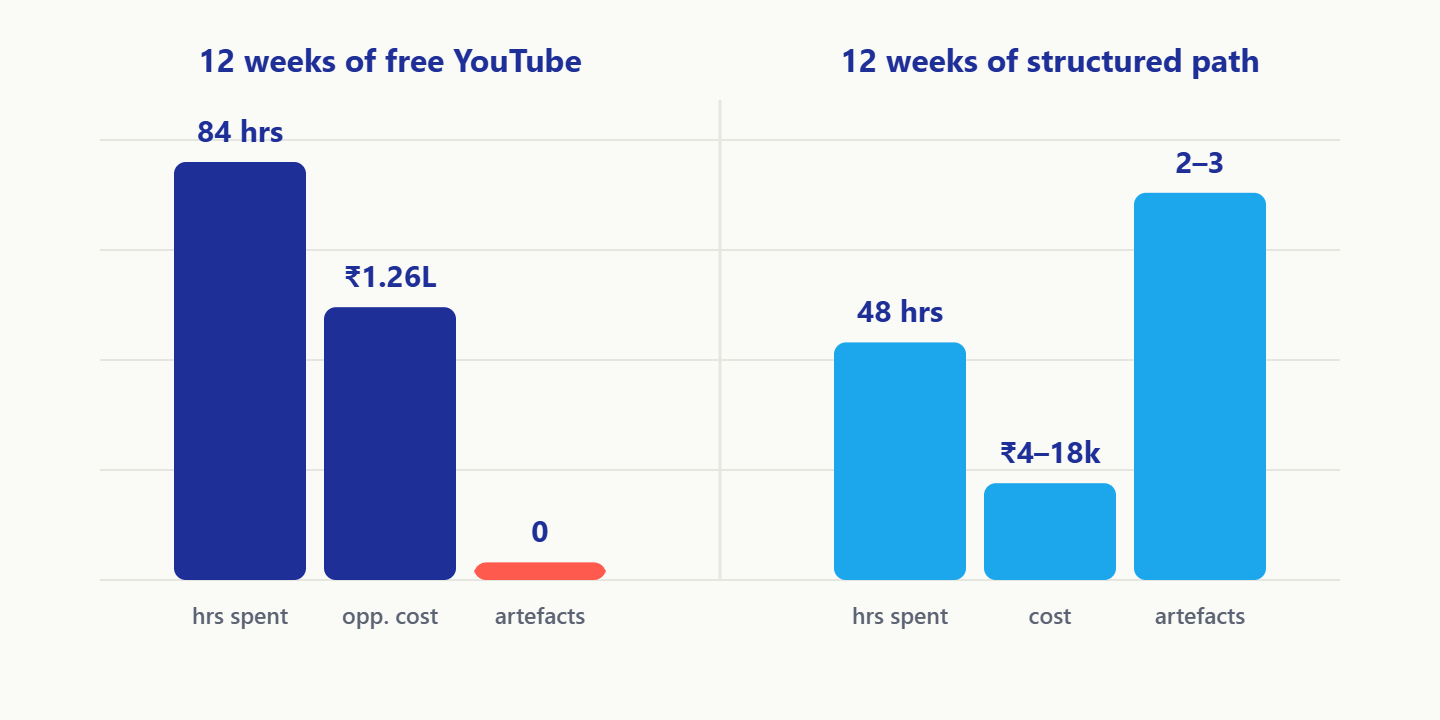
The second cost is shipped output. Across our user-research conversations, the typical “YouTube-only” learner shipped zero AI-augmented artefacts in their first 12 weeks. Not one. They knew more vocabulary. They didn’t have a portfolio.
The third cost is harder to see: decision fatigue. Free content optimises for what gets watched, not what gets learned. You’re being algorithmically nudged into the topics that get the most clicks, not the ones that close your specific skill gaps.
This is not a YouTube problem. This is what every free, ad-supported information channel does. Twitter does it. Reddit does it. LinkedIn does it. The structure of the medium guarantees it.
When free is the right choice
Be honest about this. For some learners, the “free YouTube” path is genuinely optimal.
You should stay on the free track if:
- 1You’re in the orientation phase. You don’t know what you don’t know. You need vocabulary and a mental map. Two to three weeks of YouTube exploration is the fastest way to get there. Nothing structured can compete at this stage.
- 2You’re testing whether you care. Some people watch 6 hours of AI content and realise they hate it. Better to find out cheap.
- 3You’re under 3 hours a week of capacity. Below that threshold, structured paths are too dense. You’ll fall behind and quit. Free, low-pressure content fits.
If those describe you, save this article. Come back when one of them changes.
The four signals that tell you it’s time to switch
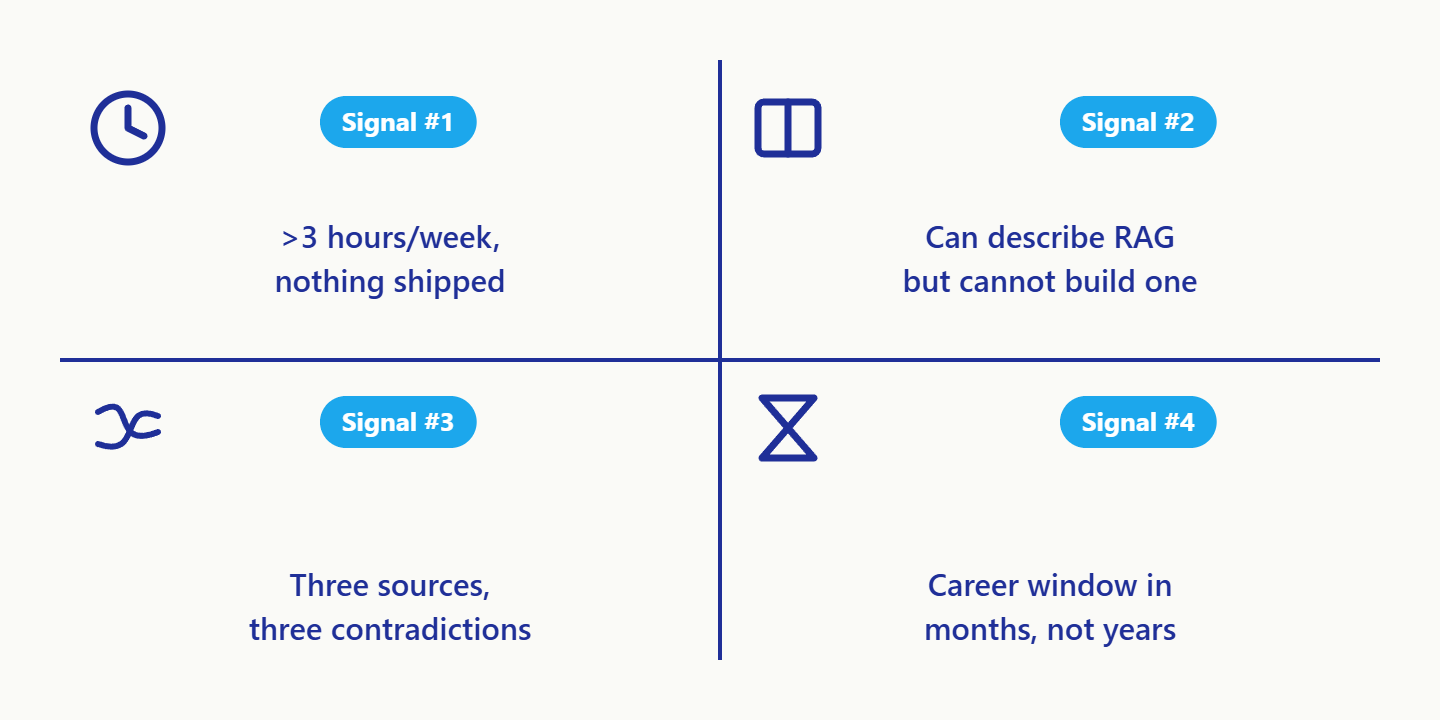
For everyone else, here are the four signals that you’ve outgrown free.
Signal 1: You’re spending more than 3 hours a week with nothing to show
If your weekly logged AI-learning time is above 3 hours and you can’t point to one shipped artefact in the last 30 days, the problem is structure, not effort.
Free content rewards consumption. Structured paths force production. The single biggest difference between someone who learned AI in 2025 and someone who watched a lot of AI content in 2025 is whether their curriculum had assignment deadlines.
Signal 2: You can describe RAG but you can’t build one
This is the “vocabulary trap.” You can explain chunking, embeddings, retrieval, and re-ranking at a dinner party. You cannot stand up a working RAG over your own documents in an afternoon.
When the gap between what you can describe and what you can build keeps widening, you need a path that requires you to ship before moving on. Free content doesn’t gate-keep. Structured paths do.
Signal 3: You’re consuming three contradictory sources on the same topic
Three creators disagree on chunking strategy. Five tutorials give different LangChain advice. The official LangChain docs say something else entirely. You spend more time evaluating which source to trust than actually building.
This is a curation problem. The value of a structured path isn’t the content. It’s the opinionated sequencing. Someone who knows the field has already done the “which sources are right” triage for you. You pay for the curation, not the videos.
Signal 4: You’re inside the career window and the clock is short
If your “AI transformation” deadline at work is 6 months away, you do not have 18 months of YouTube to wander through. The cost-benefit math on your time changes entirely when the deadline is real.
Most senior Indian ICs underestimate this window by a factor of 2. The cost of not shipping in time isn’t “I’ll learn next year.” It’s “my role gets repackaged and the AI work goes to someone else on the team.”
What structured learning is actually worth in ₹
Here’s the rough math on the swap.
A typical SurfingBear Learn track is structured around 4 hours a week × 8–12 weeks, with shipped-artefact gates between modules. The price ranges between ₹4,000 and ₹18,000 depending on track depth. Free tier for short paths, paid for cohort-led ones.
YouTube path
₹1.26 lakh / quarter
0 shipped artefacts
Structured path
₹4–18k
2–3 shipped artefacts
Compare that to ₹1.26 lakh per quarter in opportunity cost on the YouTube path, with zero shipped output.
Even if you only believe the structured path moves you 30% faster, the math works. If it gets you to a shipped portfolio in 12 weeks instead of 24, the math is overwhelming.
This is not because the content is better. Free YouTube creators in India in 2026 are genuinely world-class on many topics. It’s because the sequencing, deadlines, and forced output are different products from videos.
You’re not paying for the lectures. You’re paying for the shape of the path.
How to switch without wasting the YouTube hours
If you’ve decided to move, don’t discard the YouTube months. Use them.
- 1List the topics you’ve already covered well on free. RAG basics, vector DB conceptual model, prompt engineering 101. Skip those modules in any structured path you join. Most platforms, including SurfingBear Learn, let you test out.
- 2Pick a path that starts where you actually are. Beginner paths are not for senior ICs with 9 months of YouTube under their belt. Look for intermediate or applied tracks.
- 3Set a portfolio gate, not a completion gate. Your goal isn’t to finish the course. It’s to ship 2–3 portfolio artefacts inside the course. Drop out the day you have those, even if Module 8 is still pending.
- 4Block 4 hours on your calendar. Same slot, same day, every week. If you don’t block it, you’ll drift back to YouTube within two weekends.
The decision, simplified
YouTube is the right tool when you’re orienting, testing interest, or under 3 hours a week.
Structured learning is the right tool when you have output deadlines, a real time budget, and a quantifiable career window.
The transition point is when “free” stops being free.
For most senior Indian ICs reading this in mid-2026, with their VP’s AI transformation email already sent, that point is now.