

You have sent forty applications this month. You have heard back from two. The resume looks good — you spent a weekend on the template, the spacing is clean, the sidebar has a nice accent colour. And still, nothing.
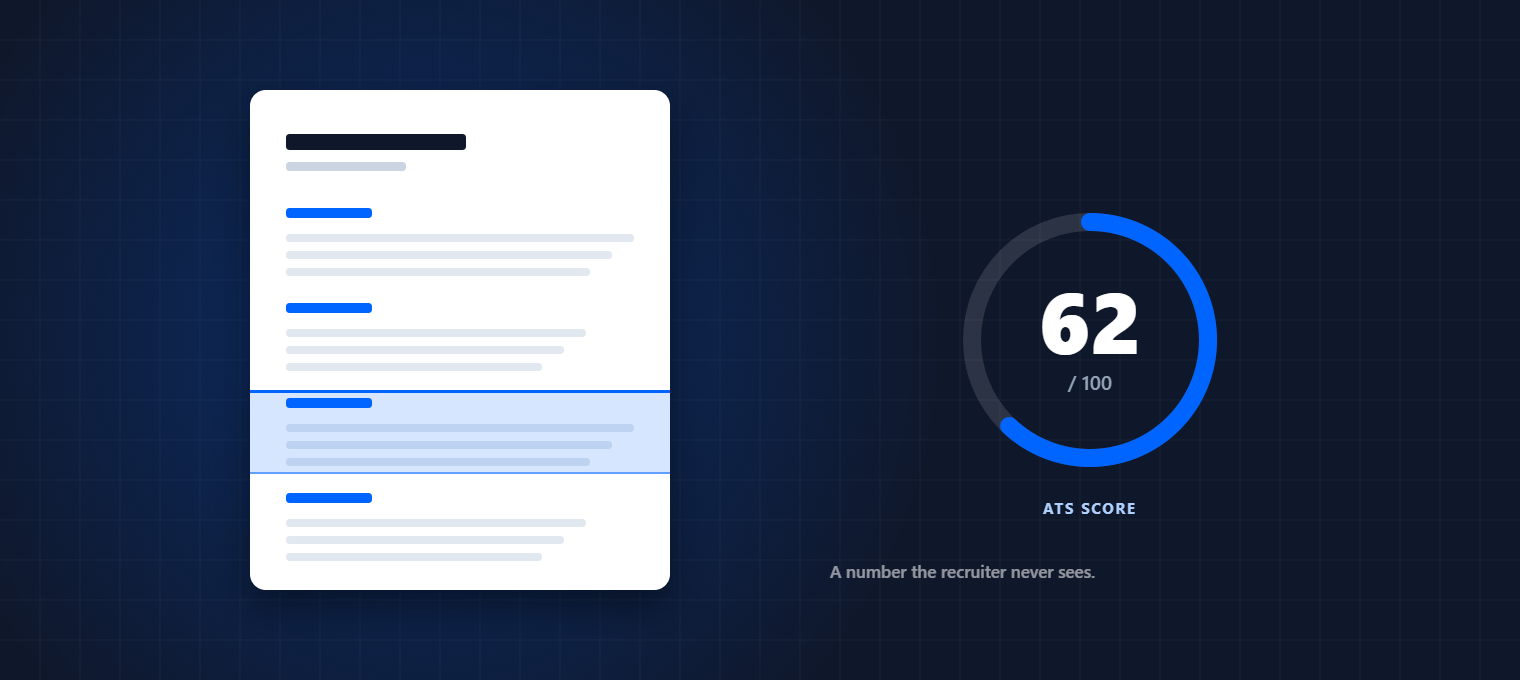
So you search for a free ATS resume checker, upload the file, and get a number back. 62 out of 100. Now what? Is 62 bad? Does the company see that number? Should you be chasing 90?
Here is the part almost every article about this gets wrong, and it changes everything about how you use the tool.
The score you just got was generated by the checker. It was not generated by the employer’s system. No applicant tracking system anywhere is computing an 87 and using it to sort you. That number is a proxy — a genuinely useful one — for a much more specific question: can a machine read your file without mangling it?
Because when a resume parses badly, it does not get rejected. It gets stored wrong. Your last employer lands in the education field. Your skills section becomes one unreadable blob. And then you simply never surface when the recruiter runs their search.
You were not turned down. You were never found. Different problem, same silence — and it is the problem a free ATS checker actually solves.
What an ATS actually does
An applicant tracking system — Workday, Greenhouse, Lever, Naukri RMS, Zoho Recruit — is a database. Nothing more mysterious than that.
When you apply, it does three things. It parses your file into structured fields: name, email, companies, dates, titles, skills. It stores you as a searchable record. And it lets a recruiter filter that database — by keyword, by years of experience, by location, by degree.
That is the whole mechanism. There is no hidden scoring engine inside Workday deciding your fate, and there is no algorithm rejecting you at midnight. There is a recruiter typing a search query and looking at whoever comes back.
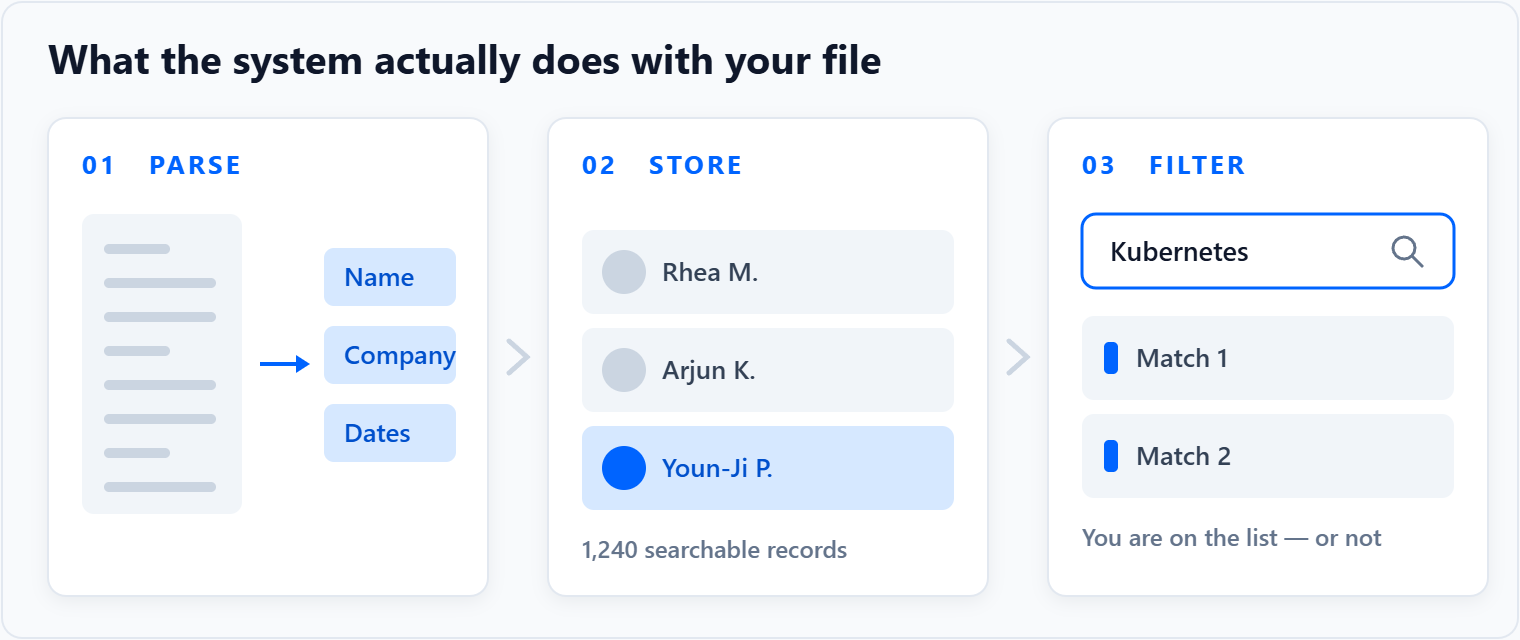
Which means your real enemy is not rejection. It is step one failing quietly.
A recruiter searching for Kubernetes gets a list. If your file parsed cleanly, you are on that list and your five years of Kubernetes work is visible. If it did not, you are in the database — you just are not in the result.
This is why the ATS score matters despite not being a real ranking. It is measuring whether you are findable at all. And findable is the entire game before anything else can happen.
What an ATS score really measures
Every free ATS checker on the market is scoring roughly the same five things, in roughly the same order of importance.
Parse integrity carries the most weight, because it is the thing that can zero out everything else. Then keyword match against the job description. Then section structure, formatting hygiene, and finally whether your contact details came through correctly.
A high score means your resume is machine-legible and relevant to that specific job. It does not mean your resume is good. Those are two separate audits and you need both — a perfectly parsed resume describing unremarkable work still gets you nowhere.
The four failures that actually happen
Run enough resumes through parsers and the failures stop being random. They cluster into a handful of repeat offenders. Here are the four that account for most of the damage.
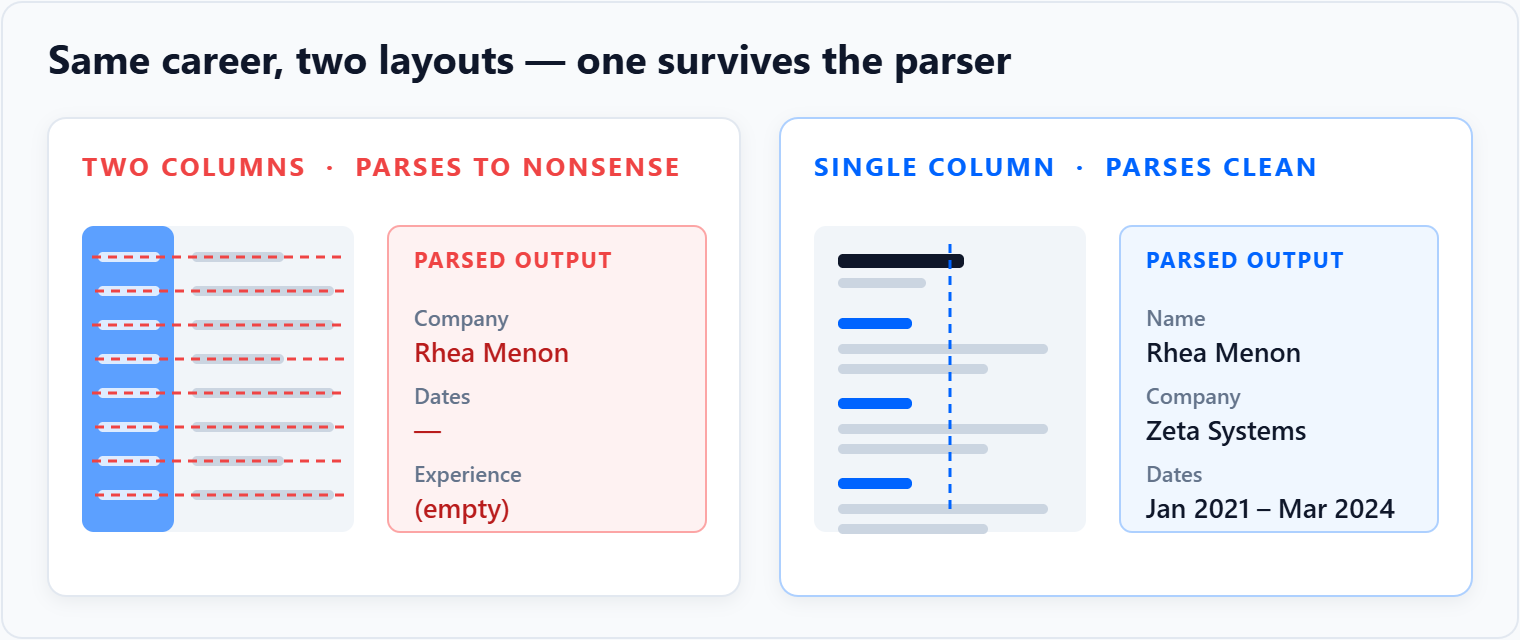
Your work history comes back empty or scrambled
Almost always a two-column layout. The parser reads left to right across the full width of the page, so it interleaves your sidebar with your main content and produces nonsense.
The fix is unglamorous and non-negotiable: single column. Those elegant templates with a coloured sidebar are the single most common cause of a resume parsing into garbage, and they are popular precisely because they look good to humans. Design for the parser first — the recruiter reads it second.
Your name appears as the employer
This means your name and contact details were sitting in the document header. Many parsers skip headers and footers entirely, or misattribute whatever they find there.
Move every single word out of headers and footers and into the body of the document. Same for anything in a text box — parsers treat those as separate objects and frequently drop them.
The checker says you have zero years of experience
Mixed date formats. You have written Jan-21 in one role, 2021– in another, and 01/21 in a third. The parser cannot build a timeline it trusts, so it returns nothing.
Pick one format and use it everywhere: Jan 2021 – Mar 2024. Spell the month, use four-digit years, use the same dash. It takes five minutes and it recovers your entire career history.
Low keyword match despite genuinely relevant experience
You wrote the concept, the job description wrote the term. Your bullet says handled production outages. The job description says incident response. The system sees no match, even though you are the stronger candidate.
Say both. Not as a trick — as translation. You are not adding claims, you are aligning vocabulary so the machine can recognise what you already did.
The ten minutes that changes the arithmetic
Here is the trade nobody frames properly.
A free ATS check is a one-time, ten-minute fix applied to a file you will send dozens of times. The alternative is discovering the same parse error forty applications later, or never discovering it at all.
Check once, then apply
10 min one-time
Every application after this one is readable
Apply, then wonder
40+ applications
Same invisible error, forty times
That is the entire case for running the check. It is not that the tool is magic. It is that the error is silent, repeatable, and multiplies across every application you send.
Do it in this order, because fixing keywords before fixing parsing is wasted effort — the parser cannot see your keywords yet.
First, run the free parse test yourself. Open your PDF, select all, copy, paste into a plain text editor. What you see is roughly what the ATS sees. Scrambled, out of order, or missing sections? Stop and fix that before anything else. This costs nothing and catches most real failures.
Then run a checker against a real job description — not a generic score. A score without a target job is measuring almost nothing. And when you are done, re-run once and stop. Chasing 95 to 98 is procrastination wearing a productivity costume. Above roughly 80 with clean parsing, you are done. Go apply.
Four fixes, in the order that pays
If you only have half an hour, spend it here.
The part no ATS checker can fix
A free ATS resume checker moves you from invisible to visible. That is a real jump, and it is worth the ten minutes. It is also the entire job of the tool.
But visible is not hired. Once your resume parses cleanly and matches the posting, you are in a pile with everyone else whose resume also parses cleanly. What separates you then is what is actually behind the bullets.
In 2026 that gap shows up in one specific place. Hiring managers have stopped asking whether you use AI tools. They ask what you have shipped with them. Familiar with ChatGPT now reads the way proficient in MS Office reads — it says nothing. Built an internal RAG tool that halved our support triage time, here is the repo is a different conversation entirely.
An optimizer can make sure that line gets read. It cannot make the line true. That is the honest boundary, and we would rather say it plainly than sell you something that does not exist.